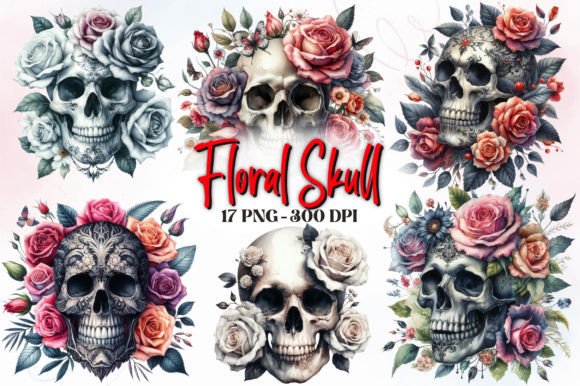
The Artistic Fusion of Life and Mortality in Watercolor Floral Skull Clipart
Deconstructing the Visual Symbolism
The intersection of macabre imagery and delicate botanical illustration creates a visual paradox that has captivated designers, educators, and artists for decades. When exploring Watercolor Floral Skull Clipart, one is not merely looking at a decorative asset but engaging with a rich tapestry of art history and semiotics. The skull, traditionally a universal symbol of mortality and the transient nature of existence, is softened and recontextualized through the application of watercolor florals. This juxtaposition transforms a stark reminder of death into a celebration of the cycle of life, making it an accessible motif for diverse audiences ranging from commercial brand managers to academic researchers studying visual culture.
Understanding this specific clipart category requires analyzing the medium itself. Watercolor, by its very nature, is fluid, transparent, and organic. Unlike vector graphics which offer mathematical precision and solid fills, watercolor introduces an element of controlled chaos. The bleeding edges and varying opacity mimic natural decay and growth simultaneously. When applied to skeletal structures, the paint softens the hard lines of bone, suggesting that nature is reclaiming the form. For professionals selecting assets for sensitive projects, recognizing this emotional resonance is crucial. The imagery does not evoke horror; rather, it evokes nostalgia, remembrance, and the beauty found in impermanence.
Cultural Resonance and Modern Adaptation
While the aesthetic has roots in European memento mori traditions, its current popularity in digital clipart is heavily influenced by Latin American iconography, specifically Día de los Muertos (Day of the Dead). In this cultural context, the decorated skull is not a symbol of grief but of joyful remembrance and ancestral connection. Digital assets labeled as Watercolor Floral Skull Clipart often bridge these cultural gaps, offering a stylized version that respects the celebratory nature of the tradition while adapting to global design trends.
For educators and cultural institutions, utilizing these assets provides an opportunity to discuss cross-cultural perspectives on mortality. However, it also necessitates a mindful approach to appropriation versus appreciation. High-quality clipart in this niche often distinguishes itself by incorporating culturally accurate floral choices—such as marigolds (cempasúchil) or roses—rather than generic botanicals. Recognizing these nuances allows creators to use the imagery with greater depth and respect, elevating their work beyond mere decoration to meaningful visual communication.
Technical Considerations for Professional Implementation
For graphic designers and business owners integrating Watercolor Floral Skull Clipart into commercial workflows, technical specifications are just as important as aesthetic appeal. The organic nature of watercolor presents unique challenges in digital reproduction that must be navigated carefully to maintain professional standards.
- Resolution and Scaling: True watercolor textures rely on paper grain and pigment sedimentation. Raster-based clipart should ideally be sourced at 300 DPI or higher to preserve these micro-details. Upscaling low-resolution files results in pixelation that destroys the illusion of painted media. Professionals should prioritize assets that include high-resolution PNGs with transparent backgrounds or vectorized versions where the texture has been meticulously traced.
- Color Profile Management: Watercolors are renowned for their luminosity, which can be difficult to replicate across different output devices. Assets intended for print should be verified in CMYK color space to prevent the vibrant teals and magentas common in this genre from appearing muddy. Conversely, RGB versions are necessary for web and screen applications to maintain vibrancy. Understanding the intended end-use before acquisition prevents costly reprinting or redesigns.
- Transparency and Blending Modes: The value of floral skull clipart often lies in its ability to layer. Files with clean transparency channels allow designers to place the skull over textured backgrounds or photographs without harsh white boxes. Advanced users should look for assets that support blending modes like Multiply or Overlay, enabling the watercolor texture to interact naturally with underlying design elements rather than sitting flatly on top.
- Compositional Balance: Unlike symmetrical logos, watercolor skulls are often asymmetrical due to the hand-painted nature of the source material. Designers must account for this visual weight when creating layouts. Negative space within the floral arrangement is as important as the painted areas, providing room for typography or other graphical elements without creating visual clutter.
Licensing and Ethical Sourcing
In the digital asset marketplace, provenance matters. The market for Watercolor Floral Skull Clipart is saturated with AI-generated content and unauthorized derivatives. For businesses and researchers requiring verifiable authenticity, understanding licensing tiers is essential. Commercial licenses typically cover end-products for sale, while extended licenses may be required for templates, print-on-demand services, or digital redistribution. Furthermore, supporting original artists who hand-paint and digitize their work ensures the continuation of authentic craftsmanship in an increasingly automated landscape. Verifying the creator’s portfolio for consistency in style and brushwork can help distinguish genuine artistic assets from algorithmic approximations.
Diverse Applications Across Industries
The versatility of this specific visual motif extends far beyond seasonal Halloween decorations. Its unique blend of edge and elegance makes it applicable in sectors where traditional skull imagery would be considered inappropriate or too aggressive.
Educational and Academic Contexts
In anatomy education and biological sciences, standard skeletal diagrams can sometimes feel clinical or intimidating to new students. Incorporating Watercolor Floral Skull Clipart into introductory materials, study guides, or presentation slides can humanize the subject matter. The artistic rendering serves as a cognitive bridge, acknowledging the humanity of the specimen while maintaining scientific accuracy in structure. Researchers presenting on topics related to archaeology, anthropology, or forensic science may also utilize these visuals to soften the impact of sensitive subject matter during public outreach or conference presentations, making complex discussions about mortality more approachable for general audiences.
Commercial Branding and Product Design
Retailers and product developers have found significant success using this aesthetic in categories targeting demographics that appreciate alternative romance or gothic cottagecore styles. Stationery, apparel, home decor, and cosmetic packaging frequently leverage these designs to signal a brand identity that is both edgy and sophisticated. The key to successful commercial application lies in restraint. Because the clipart is visually dense, it often works best as a focal point against minimalist backgrounds. Business owners should consider how the color palette of the florals aligns with existing brand colors; customizing the hue of digital watercolor assets allows for seamless integration without sacrificing the organic texture that defines the style.
Therapeutic and Wellness Spaces
Surprisingly, this imagery has found a place in mental health and grief counseling resources. Art therapists and counselors working with clients processing loss may use floral skull imagery as a non-verbal prompt for discussing acceptance and transformation. The visual metaphor of flowers blooming from bone aligns with therapeutic concepts of post-traumatic growth. Journals, worksheets, and mindfulness cards featuring these designs provide a safe, aesthetically pleasing container for difficult emotions. Unlike stark anatomical drawings, the watercolor interpretation invites projection and personal meaning-making, making it a valuable tool in expressive arts therapy.
Navigating Trends Versus Timelessness
While currently trending, the fusion of botany and osteology has historical staying power. To ensure longevity in design projects, creators should focus on classical composition principles rather than fleeting stylistic gimmicks. Trends often push toward neon colors or excessive digital effects, but the most enduring examples of Watercolor Floral Skull Clipart adhere to traditional painting techniques and naturalistic color palettes. Observing the interplay of warm and cool tones, the direction of light, and the botanical accuracy of the flora can help distinguish timeless assets from dated ones.
Furthermore, the evolution of this genre reflects broader societal shifts in how we visualize and discuss death. As conversations around end-of-life care, eco-friendly burial practices, and death positivity gain mainstream traction, the demand for imagery that balances solemnity with beauty continues to grow. Professionals who understand this underlying cultural current can utilize these assets not just as decoration, but as part of a larger narrative that resonates deeply with contemporary values. Whether used in a marketing campaign, a classroom lecture, or a personal creative project, the thoughtful selection and application of watercolor floral skull imagery demonstrates a sophisticated grasp of visual language that speaks to the complexity of the human experience.
Practical Workflow Integration
For hobbyists and creators new to working with raster watercolor assets, establishing a consistent workflow enhances efficiency. Organizing clipart libraries by color temperature, floral type, and orientation saves valuable time during the design phase. Creating smart objects in software like Photoshop allows for non-destructive resizing and color adjustments, preserving the integrity of the original watercolor texture. Additionally, pairing these ornate illustrations with clean, modern typography creates a necessary contrast that improves readability and prevents the design from becoming overwhelming. Testing prints on actual paper stock before finalizing projects is also advisable, as watercolor textures can absorb differently depending on paper coating and weight, significantly altering the final appearance compared to screen previews.